If Grenache were a Shakespearean play it would have three acts, starring David & Nadia Sadie, with long soliloquies on the control of power.
Act One.
Why Grenache?
“Because it belongs here.”
The fact that South Africa only has 11ha of old vine Grenache in the ground doesn’t make sense given that it is built to withstand the effects of global warming. With three consecutive years of serious drought it seems strange that Grenache acreage hasn’t gone through the roof. As a natural survivor, and with global warming here to stay, Grenache should too.
Cape plantings of the grape are growing across several regions, though the Swartland seems to be its natural kingdom. Suited to the various soils and conditions of this diverse region, from the granites of Paardeberg, the iron-rich clays of Malmesbury, the schists of Kasteelberg, and everything in between.
Apart from David & Nadia, outstanding examples are being produced by the likes of Adi Badenhorst and Marelise Niemann of Momento in the Paardeberg. Recently planted bush vines on shale soils in Botriver are also showing great promise under the guidance of both Marelise and Anaïsbos. While definite outliers are the vines of Strandveld in Elim in the harsh maritime conditions of Cape Agulhas and the 0.9ha of old South African and French clones David Nieuwoudt of Cederberg has just planted at 1036m above sea level – demonstrates the grape’s great diversity. As well as the producers' belief in it.
The Old Vine Project has proven a necessary force in finding and recovering old Grenache vines. And while OLD doesn’t always mean GREAT, there is usually a reason for the surviving vines to have escaped uprooting. For reasons and qualities treasured by the guardians of these vines, and lovingly vinified into singular wines with real stories.
Act Two.
When?
“It’s a long story.”
David Sadie is a firm believer in the wisdom of old people. Their experience is invaluable. He has never been a big pioneer of new varieties and with the proof of global warming and the history of Grenache making its way here in the 1700s, there is a lot to build a future on.
While Grenache has a long history in South Africa, it is not as glamorous as that of Cabernet Sauvignon, or as prized as the age-ability of Cinsault. Grenache, back then, like the other big-berried varieties, was associated with the simple, cheap, and sweet jug wines of California and Australia.
Piekenierskloof used to be the Kingdom of Cape Grenache, but in 1918 under the cooperative powers of the KWV, some of the farmers wanted to be independent and uprooted their vineyards in favour of rooibos, cattle, sheep, and the like. Almost all the old vine Grenache was lost. Eben Sadie’s Soldaat comes from one of these old Piekenierskloof vineyards spared from mass extinction – and thus very precious indeed.
Throughout the world, old vine Grenache is experiencing a revival and a welcome comeback. Wines built on capturing its red-fruited, floral beauty with the concentration of an old vine backbone and the complex layers expected of great wines.
Its cruel past is a painful reminder of the aggressive uprooting schemes of the late 1900s when Grenache vines were pulled out in favour of varieties offering the absolute opposite or far less. Whether in terms of yield, or the potential to be built into the liquid version of Arnold Schwarzenegger. The ultimate beauty of Grenache does not come in dense colours and fruit en masse. These custodians of time are instead masters of communicating place through its understated nature of captivating perfume, fine powdery tannins, and delicate layers of power.
Once a popular variety for the Port-like fortified wines of the Cape, Barossa Valley, and McLaren Vale in South Australia, achieving both high yields and rewarding sugar ripeness in these hot arid regions. This trend eventually made way for dry reds, the variety falling out of fashion for not suiting the big, extracted styles of modern times. It was still picked late, pushing for high potential alcohols, worked hard, with more new oak than it could handle, just to ensure power. Ultimately treated like a full-bodied Shiraz rather than preserving its graceful stature and seductive prettiness, which is so attractively distributed among its structural layers. The key to capturing the beauty of Grenache is to treat it as a Pinot Noir, allowing it to stay true to itself. Light in colour but not weak, a sentiment that holds true for both Pinot Noir and Grenache.
Act Three.
How?
“Distracted or Confused?”
With only 11ha of old vine Grenache left in South Africa, if you want to build your future on Grenache, you’ll have to plant it yourself. This is why David & Nadia have been focussing on establishing new Grenache vineyards since the early 2000s, today five Swartland vineyards form the core of their production.
But how?
Grenache is not a shy bearer. And on top of being a fertile grower, it is big-bunched and big berried, already making for a real challenge if you’re aiming for top-quality grapes. Add to this, the old South African clone (70), the most planted clone here, with the largest berries. Requiring time to tame the generosity of the young vine and therefore triple the challenge, but also triple the reward. IF you can crack the code.
Logically the easier route would be to focus on the smaller berried French clone (513) which allows a higher skin to juice ratio to increase the concentration and naturally make for a more interesting wine. But David Sadie, the incredibly talented and understated gentle giant is convinced that this is not the route for them.
When you get it right with the old clone the rewards are too good to be tempted by this shortcut. If you think like David Sadie that is. He doesn’t believe in reinventing the wheel, preferring to stick to the wisdom of the ones that came before. Their experience. And after having had the privilege of tasting an old magnum bottling of Piekenierskloof Grenache made by the legendary Jan Boland Coetzee, he is even more convinced that this is the ONLY way to go.
To decode old clone Grenache you do a green harvest, a rosé harvest after veraison, and THEN the real harvest. From the same vines. Adding even more vineyard work, as if the vines start sensing that you are trying to trick it with taking off too much of its crop too early, which might cause confusion and make it start redirecting its energy into other directions, always eager to overcrop. It was always going to be a challenge, but if the quality rewards are high enough. It’s worth it.
It’s no coincidence that Grenache is so successful in dry regions with low rainfall as it sets natural limitations on its power to grow. The lack of water restricts growth forcing it to become more concentrated. An amazing variety with its heat and drought resistance. It loves warm slopes, poor soils, and requires half the water of Syrah. Rewarding itself with beautiful bunches.
David & Nadia is one of the very few producers in the Cape building their future on Grenache. Year on year the quality outshines itself. Having tasted all the vintages from 2016, THEIR future has kicked off with a bang by all accounts. It will make international headlines, the quality of Grenache across the Cape. There will be more heatwaves. Challenging droughts. And Grenache will weather it all, waiting out the storm, with admirable confidence. The “Pinot of the South”.
David & Nadia Elpidios 2019
Grenache leads this unique Swartlandian heritage blend highlighting its intrinsic fragranced wildness winningly. With a generous percentage Syrah, and splashes of Pinotage, Carignan, and Cinsault adding more densely textured qualities and “flesh on the bone” to the tightly focused core. The perfect port of entry to the world of Mediterranean blends, with a refreshingly confident South African twist. Its power lies in the intensity of its fine layers and not being unnecessarily opulent or broad-shouldered.
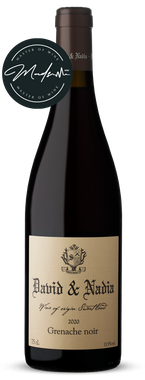
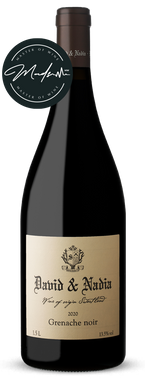
David & Nadia Grenache Noir 2020
This is an absolutely stunning example of what Grenache, our unsung hero, is capable of when firmly and happily rooted in this forbidding place. Embodying the phrase “less is more,” it is elegantly powerful. Daring to show off its spellbinding rosehip, aniseed spice, and lavender perfume wrapped around an aromatic red-fruited prettiness. With serious structural confidence, this is a wine that deserves world recognition. Grenache, you are here to stay!