Stellenbosch Cabernet Sauvignon has always been one of the real established classics, but maybe more as a Cab-led blend than a straight Cab. Back then, inspired by the great wines of Médoc, rather than Napa Valley which seems to have become a more tempting style to follow. For some. Aspirational pricing and market powers, too.
But the Stellenbosch classics haven´t always been in vogue. Especially in recent years with so many “new cool kids on the block” making waves and producing some truly exciting and innovative wines with eye-catching labels and a marketing approach connecting with a younger generation looking for a bit of a thrill rather than tradition. South Africa was actually in desperate need of these young-ish rebels to bring the necessary level of hype into the somewhat stale, too established, Stellenbosch wine scene, which sometimes showed signs of becoming complacent. This competition can be credited for South African wine's current momentum. The timely generational shift on many estates is also a very strong reason for the new direction. But I will keep repeating my mantra: Don´t forget the classics!
As a Southern Hemisphere wine region, South Africa is always fighting against the preconceptions surrounding the "New World", and without producing a classic Cabernet Sauvignon, or Cab-led blend, to stand alongside its global competitors, would never be considered a world-class wine country. That is why California sits so comfortably on international wine lists alongside its classic European counterparts. Boldly priced. But a worthy competitor. And probably why so many producers decide to chase a style with the help of a recipe instead of getting down to the hard work required to nail down a true identity. It takes a lot of confidence.
The search for identity
Did South Africa loose its identity trying to please the world?
Despite almost 370 years of winemaking history, SA is still a very young wine industry. Having entered into the highly competitive world of wine exports only 25 years ago. There is still a constant search for it, both as a winemaking nation and individual producers.
Often suspended between hope and despair, bouncing from strong-minded importers and demanding buyers, requesting certain styles to match a price point, requiring you to further adapt to current market trends. As well as striving to attain a high score from opinion-making critics, whether they are of local market value or offering solid international acclaim. The dream scenario of being awarded a 95+pointer has the potential to turn your world around. Or not. There are too many
variables involved to guarantee success. Or not. All of this, while somehow at the same time feeling confidently convinced that the most important guiding light to follow is staying true to what has worked well in the past and what once made you successful. Before current local and global trends made you question your ability to make the right decisions and trust your previously capable gut.
The power of sub-regionality. Or not?
If Stellenbosch is such an established brand as wine of origin, how relevant is it to communicate one of its 8 subregional viticultural pockets on the label? How small do you want to go? And what will be gained from this? Do you have many like-minded winemakers in your neck of the woods who can join forces with you in making your little corner of Stellenbosch famous in its own right?
When you are part of a strong brand, which carries the name of a historically famous town, a respected delineation, do you really want to confuse the consumer by digging yourself into a hole by labelling your wine with one of the eight lesser-known subregions? And especially one that has become known for things other than wine. Like Jonkershoek Valley, with its beautiful Nature Reserve. Bikers and hikers, trail runners and baboons. And who knew that the life-enriching Eerste Rivier starts its journey in the Jonkershoek Mountains? Sadly though, whenever there is a fire sweeping across the mountains, Jonkershoek often gets scorched to ashes, threatening the vineyards clinging onto its slopes.
So, WHO is making Jonkershoek famous for its wine?
Jonkershoek
The first-ever wines I tasted on South African soil in 1994, an hour after touchdown in Cape Town, were Rozendal 1983 and 1984 from their Jonkershoek vineyard planted to Merlot, Cabernet Franc, and Cabernet Sauvignon. The closest comparison to Pomerol back then.
Those vines had to be pulled out long ago. However, their next-door neighbour’s vineyard is still going strong and was planted in 1905; Mev Kirsten’s Chenin Blanc. A historic Jonkershoek diamond in Eben Sadie´s stable of bottled heritage.
Other small pockets of Jonkershoek greatness can be found in the hands of Warren Ellis, who produces an excellent example of a very classic Cabernet Sauvignon under the Neil Ellis Jonkershoek Valley label. And proudly, a third of the much-hailed Le Riche Cabs have been nurtured in this same valley.
But that´s it! Apart from Stark-Condé!
Stark-Condé
José Conde is one of the most humble wine guys in the Stellenbosch wine tribe. He keeps a low profile, with integrity. Overall, such an incredibly NICE human being. It's just not in his nature to be loud and noisy to get his point across. Dare I say, DESPITE his still broad Missouri-accent.
He has always been so resolutely against “being cool” and at the same time so totally unaware that he was probably one of the FIRST cool “garagiste” winemakers back in 1998 when making his first Stellenbosch Cab and Three Pines Cab in a small shack on the farm.
This guy is a smart operator, and I don´t think anything can distract him from his vision, maintaining such a strong focus on expressing the best of what these Jonkershoek vineyards have to offer in the bottle. In a very stylish, classic approach.
But the whole Oude Nectar farm is not suited to the classics. An example of José´s visionary approach was a decision he made 12 years ago for a two-hectare Cabernet block situated at the bottom of a steep slope very close to the river. It was the trickiest block on the estate with a mix of 11 different soil types. No wonder it was ripening so inconsistently every year! He pulled it out and challenged the site by replacing the Cabernet with a field planting of varieties suited to match the inconsistency of the soils. Chenin, Roussanne, Viognier, and Verdelho became The Field Blend. A very clever decision; and a cracker of a wine.
Cabernet is KING
Slowly but surely the Stark-Condé wines have made a consistently solid statement. Every time I have tasted the current range, they just seem to have climbed up another notch on the quality ladder. When I was back on the farm earlier this year, I was especially blown away by the 2017 Cabernets. They really nailed everything you wish for in great Cabernets at different price points. And when following up on the recently launched 2018 reds, I was convinced that these wines deserve a lot more attention than they get.
Picking my two highlights out of this very steady portfolio was not easy, but it had to be Cabernet Sauvignon. Cabernet is king here.
50 shades of – GREEN
King Cabernet has been way too tolerant. Modelled into whatever shape and flavour its master dictates. Cab and its loyal partners in crime, Cab Franc and Merlot, all have an inherent fragrant quality in a particular shade of green. It is a part of their DNA. But so often I run into wines that have so evidently been forced into a straitjacket to mute its inherent fragrant qualities to match a certain style. As soon as you do everything in your power to avoid something, you will be guaranteed to lose something else along the way that could have brought beauty into the equation/equilibrium. Fragrance versus a jam jar.
Cool and rainy vintages in Bordeaux, those classified as right-out bad vintages, once set the standard for the term “green”, as a negative unripe, weedy character that potentially could be tamed through years of bottle age. Or not. Suddenly wine critics, high and low, were applying the term green to wines as an act of punishment when they were able to identify something relating to the colour green in a wine. And publishing a tasting note including “herbal notes” resulted in lost sales.
What about the beautiful green?
When classy, cool sites in sunny climates are being forced into extended hangtime, aiming to chase away any sign of the inherent herbal character of the grapes, to match a recipe for a fashionable style, I sympathize with the grape king. It´s like asking him to do a face transplant. Or to take an overdose of Botox.
The Wines
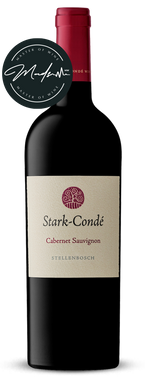
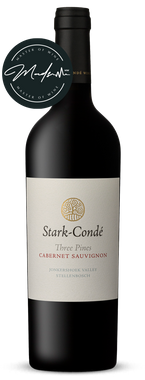
Well, this is definitely not the case for these gorgeous representations of the variety. My two highlights really nailed everything I could wish for in a classically styled Cabernet, matching their level of seriousness with their respective price tags. The Estate Blend under the Stellenbosch label is the slightly juicier version while the Three Pines with its confident gravelly power makes you sit up and listen and take note. WOW! The time has come to stand up for what Jonkershoek can be under the guidance of the Stark-Condé team.
Stellenbosch Cabernet Sauvignon 2018
This is just such an utterly gorgeous wine. Juicy yet firm, with blackcurrants and raspberry compote in the mix, it brings attractive drinkability into a classically styled frame.
Cedar and herbs with a dark core of graphite and dusty gravel in the background. This is an estate blend based on the four Cabernet blocks on the Jonkershoek property which have been further boosted by 10 percent Petit Verdot bringing both richness and persistence to the palate. This wine does not deviate too far off from the class and seriousness of the Three Pines. Just a bit more friendly and approachable in its youth compared to its big brother. This is a really smart buy.
Three Pines Cabernet Sauvignon 2018
This is a masterpiece, cleverly combining all the confident quality attributes of a unique site, turning it into a stylish class act expressing as much refinement as grunt and gravelly power. Its elevated cooler site brings the red flower and fresh herb fragrance, while its aspect allows the grapes to reach perfect maturity from long hours basking in the afternoon sun. This, without losing any of its vital freshness and crunchy, juicy blackcurrant fruit. Firmly focused, this wine convinces you of its staying power, while making it difficult to keep your hands off it also in this youthful attractive state. That´s what you can call a dream scenario for a classically styled Cabernet Sauvignon. Without a doubt, one of the best expressions of the variety in the country.