Champagne sales are in crisis. Yes, the well documented geopolitical instability and tightening consumer spend affects all in the wine industry, but alongside prices of Champagne have risen dramatically against consumer dismay at the generic quality pushed out in the most mass-produced lines of the Big Houses, or ‘Grand Marques’.
There is increased competition from wine regions elsewhere, putting out sparkling wine that is less expensive, and far more interesting than those most basic Champagne offerings. South Africa included. Consumers are increasingly in search of terroir driven wines and unique flavour profiles. Wines that show traceability of place and sustainability of substance. Produced by wineries with a face.
Climate change too is playing a role. Champagne evolved into a sparkling wine region due to its marginality. A little like England from the 1990s. Historically, Chardonnay and Pinot Noir struggled to ripen enough to make quality still wine, whilst further south in Burgundy (with the same varietal focus) growers were more successful. Ultimately, powerful merchants like Claude Moët would land on a solution for Champagne. They could purchase grapes from growers to produce sparkling wine, and they had the influence and route to market to make it work. The relationship between grower and house has been the core of Champagne since.
But as things warm up, and weather at budding and harvest is becoming less predictable, retaining quality yields and the famed tension in Champagne has become increasingly difficult. Sugar in grapes threaten unwanted potential alcohols, at the expense of softening acidities. In solution, producers are looking to ancient Champagne varietals, north facing slopes previously unfavoured for the lack of sun and sustainable viticulture to strengthen vines against disease pressure. In the cellar, sugar additions at dosage are notably decreasing – a practice employed to add a counterweight to racy acidities of the past. Some are experimenting with partial malolactic fermentation, a technique you’d more likely see in warm wine regions in producing white wine.
It has never been more important for producers in Champagne to be among their vines, forward thinking and innovative, whilst drawing on a wealth of heritage.
Such producers are the sole focus of our selections at Radford Dale Imports. A top example are the new arrivals from Champagne Pierre Gerbais, a terrific Grower producer in the Celles-sur-Ource of the Aube, the ‘rebellious south’ of Champagne and the spiritual home of the Grower movement.
Crucially, these wines embody the chaliced individuality that defines the very best of Champagne.
Champagne Pierre Gerbais
The Gerbais family have been growing vines for 8 generations. In the 1930s, the family opted to produce their own and stop selling their grapes to the Big Brands. Today, the domaine is run by Aurélien Gerbais. He’s young, assured, brilliant and admittedly more "Burgundian than Champenois" in approach. Aurélien schooled in Beaune, counting a number of top generational Burgundy peers among his friends and mentors - Gros, Grivot and Lachaux among them. Most importantly, Oliver Lamy (Domaine Hubert Lamy), one of the most influential viticulturists in France.
“We are a younger vignoble [than the Marne]. We couldn’t rely on our knowhow, and we continued to evolve. It takes the same time to get to school in Avize or Beaune. And there was always that fight between the north and the south in Champagne. So, alot of Aubois prefer to study in Burgundy and they come back with the philosophy of Burgundy.” Aurélien Gerbais
Aurélien has expanded on the work of his father Pascal, employing individual tanks for separate vinification of the 20 domaine plots, which he refers to as ‘micro-winemaking’. As Burgundy, this approach recognises the particularities of certain slopes and parcels within a vineyard. There’s an uncompromising approach to the viticultural practices here, to be ‘precise with the personality of terroir’.
The year 2021 marked a new direction at Pierre Gerbais, transitioning the range to focus on “Lieu-Dit” (named vineyard) bottlings. Each wine produced from a vineyard perpetual reserve started in 2011 and bearing the illustration of its unique terroir on the label.
From 2021, the “Grains de Celles” blend of the domaine parcels becomes a vintage wine.
The result is a thrill ride of Champagne expressions. Fleshy, intellectual and commanding real attention as they fan out in the glass.
Cheers!
The Line-Up:
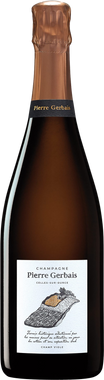
Celles-sur-Ource Lieu-Dit ‘LA LOGE’ Blanc de Blancs Extra Brut NV
From an old vineyard of Pinot Blanc, reportedly the eldest in Champagne. Gerbais are particularly well known for their championing of Pinot Blanc, among the old and somewhat forgotten varietals of Champagne and today accounting for just 0.25% of the vineyard.
The combined pressure of the once known ‘Comité Interprofessionnel du Vin de Champagne’ (CIVC) and the purchasing power of the Big Brands threatened to omit the varietal altogether, governing the growers of the Aube to plant Pinot Noir in place. Fortunately for Gerbais, the CIVC did not inspect the vineyards.
“We cheated on paper - that’s why we have Pinot Blanc.” Aurélien Gerbais
For Gerbais, Pinot Blanc was planted out of necessity. At the confluence of river valleys, the Celles-sur-Ource is particularly prone to Spring Frosts, which Pinot Blanc is less susceptible to.
Bright melon, apple skin, citrus and brioche. A textural Champagne with a pithy, layered drive and Pinot Blanc brightness. Individual and exciting.
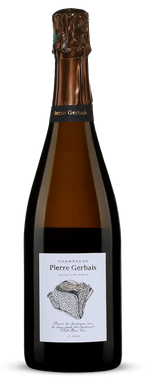
Celles-sur-Ource Lieu-Dit ‘CHAMP VIOLE’ Blanc de Blancs Extra Brut NV
Chardonnay accounts for just 10% of the vineyard in the Côte des Bar. An odd statistic for Gerbais, given the soils here are predominantly of Kimmeridgian limestone, sharing much in common with Chablis.
‘Champ Viole’ is an old Chardonnay terroir, originally selected by the Cistercian monks for its location in the heart of the hillside and its southern exposure.
Fragrant notes of blossom and lemon, whilst the palate is “thrumming with highwire intensity”. Clear varietal character on show, this is a Champagne all moulding agility and resonance.
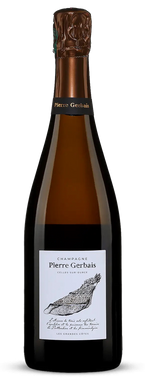
Celles-sur-Ource Lieu-Dit “LES GRANDES COTES” Blanc de Noir Extra Brut NV
Produced from a single vineyard of Pinot Noir on a combination of Portlandian and Kimmeridgian soils, with a SW exposure. The rule of thumb at Gerbais, to plant Pinot Noir on the brown soils.
The result is a tense Blanc de Noir, layered with flavours of raspberry, blood orange, and crushed stone. A gastronomic Champagne to take time on, you could certainly pair this up with gamey meats and charcuterie.
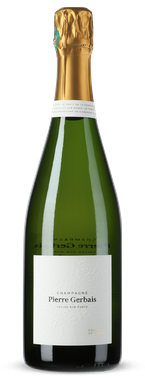
Celles-sur-Ource Lieu-Dit “GRAINS DE CELLES” Extra Brut 2021
The domaine blend from Pierre Gerbais, mirroring the estate vineyard parcels of 50% Pinot Noir, 25% Chardonnay and 25% Pinot Blanc.
A medley of wet clay, minerals, lemon and orchard fruit. Textural and creamy on the palate, with an underpinning of bright acidity. There’s a translucency and natural edge to this cuvee, in a compelling and positive sense.