Robert Mondavi
1913-2008
The father of Californian wines.
Remembering his life and his wines in Symphony.
Polite coughs as people squeeze passed drawn-up knees. Quickly now, find your seat. A pair of old ladies shush the young couple in front of them – the show’s about to start. The lights dim. The curtains go up. The conductor raises his baton, holding the tension of the room as the audience holds its breath and then, with a nod and a flick, we begin.
1st Movement: The son of Italian immigrants
Born to two Italian immigrants in Hibbing, Minnesota, Robert Mondavi’s father was sent to California by the local Italian community to buy grapes and ship them back to Minnesota for families to make their own kitchen wine – back then, the Volstead Act allowed families to make 750 litres of wine a year for their personal consumption. That’s about 9 bathtubs worth of homemade wine… Papa Mondavi fell in love with California and within two years moved to Lodi, California (the then wine capital of the state) and started his own grape shipping business. How the Italian community of Hibbing, Minnesota managed to make their annual 9 bathtubs worth of wine after this is not part of the musical score.
2nd Movement: A family business goes up in fur
In a faltering minor key, Robert Mondavi’s first wines were, well, not world class. His first job straight out of Stanford was at Sunny St. Helen winery in Napa Valley, where they made wine from purchased grapes and sold bulk juice for other wineries to bottle. He convinced his father to buy Charles Krug Winery in 1943, by explaining how they could make a serious profit by buying Sunny St. Helen’s bulk wine and bottling it under the Charles Krug label. His brother, Peter, took on the role as winemaker, while Robert used his charisma and took care of sales. The brother’s worked under ever-growing tensions – cue crescendo and timpani drums – for 23 years, until the Incident Of The Fur Coat.
The fur coat enters the scene, blown in by the horn section. This wasn’t just any fur coat, this was the fur coat Robert Mondavi bought is wife to impress the Kennedys at a White House dinner. Peter accused him of spending money belonging to the winery and a fist-fight ensued (percussion! cymbals!), no doubt upending the dinner table and breaking the family china. Robert was fired from Charles Krug. At the age of 52 he was jobless and careening towards a zero sum bank account.
3rd Movement: A Remaking
Robert Mondavi insisted that America was second to none when it came to creating elegance and enjoying it. With that in mind, he founded the Robert Mondavi winery in 1966, within a year of leaving Charles Krug. It was the first new winery in Napa Valley since the 1930s. He also changed the pronunciation of his surname to mon-DAH-vi, from his family’s mon-DAY-vi. The blood of the covenant is thicker than the water of the womb, especially considering he sued for his share of Charles Krug and ended up with his family’s key Oakville vineyards.
Mondavi had a vision: to prove to the world that Californian wines were as good as the best from Europe. He pioneered Fumé Blanc (his signature Sauvignon Blanc inspired by France’s Pouilly-Fumé) and produced some of the best Cabernet Sauvignons in the world. His winery became the top tourist destination in the area. While his ideals were viewed by many as whistling in the dark, it’s because of him that Napa Valley has become of the world’s great wine regions.
4th Movement: Opus One, a Swan Song
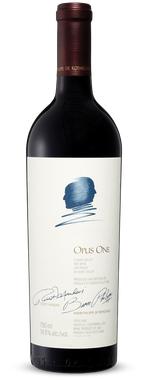
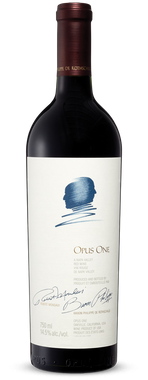
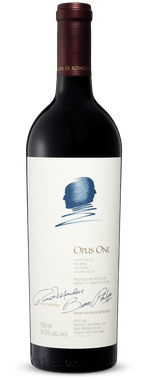
What started out as a conversation in Hawaii in 1970 (after all, this is a modern symphony complete with ukulele section), led to the 1980 founding of Robert Mondavi’s magnum opus with Baron Philippe de Rothschild of Château Mouton Rothschild: Opus One. It was a fusion of French and California, Old World and New, of tradition, of winemaking, of passion. It has become a Californian Grand Cru and one of its most famous wines. Only 12,500 cases are sold outside the US.
Violin bows poised and quivering, the cello strings announcing the opening bars, the stage is set for the introduction of the 2014 vintage, the 34th Opus One in the chorus line since the founding of the winery. Perhaps a little shy, a little blushing, it is still evident to the audience that this is the star of the show. In the words of Antonio Galloni, “The 2014 is not an obvious Opus One, like the 2010, 2012 or 2013, but over time, I will not be surprised if it challenges or even surpasses some of those vintages.”
Encore: The Overture, a bonus track
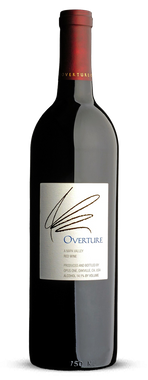
An orchestral introduction, a suggestion, an approach designed to get a reaction, a stand-alone piece of music. Introduced in 1993, Opus One’s second label, Overture, is more than a musical preamble to get the audience to quieten down for the beginning of the show, this wine is a multi-vintage reflection of the winemaker’s artistry. It is a romantic overture, the perfect first date to Opus One.
Applause. The curtains close.