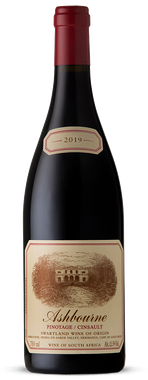
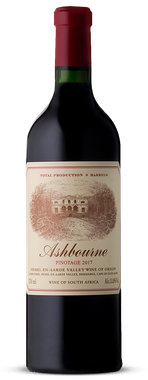
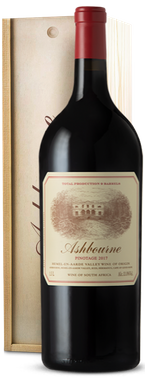
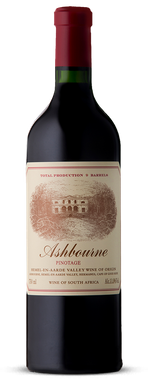
There is still time for this to become a South African truth, in fact, we’d argue that the stage has been set given the most recent Pinotage offerings from the likes of Kanonkop, Rijk's, Raats Family Wines, Southern Right, and Ashbourne. A few years back, we were invited to attend the launch of Ashbourne’s first single-varietal Pinotage made entirely from Hemel-en-Aarde grapes. The 2015 vintage is a statement about a number of things:
* The potential of successfully growing this early ripening grape in the ‘cool climate conditions’ of the Hemel-en-Aarde Valley;
* The fact that over the years we’ve learned a number of things about how to temper and tease out its best characteristics;
* We’re starting to learn the VALUE of a well-made Pinotage.
Ashbourne comes from the Hamilton Russell stable of brands and is not the only one of their number producing Pinotage, the Southern Right brand does so to great effect as well. Anthony Hamilton Russell himself is a man who talks passionately about Pinotage, so much so that we went out and bought MORE Pinotage after our encounter to see WHAT he was talking about…and then proceeded to circulate the message, as we’re doing now. We’ve subsequently concluded that you’d be better off getting your information from the proverbial horse’s mouth, given his eloquence, and invite you to read our conversation here:
* It is important to note here that Ashbourne currently produces two Pinotages, the one their flagship, single varietal Pinotage made from Hemel-en-Aarde fruit. And their Pinotage/Cinsault blend originating from the Swartland, the fast ripening of the grape and the heat of the terroir allowing for earlier enjoyment.
Where does this deep-seated belief in the potential of Pinotage stem from? And if connected to a wine, what wine was it that first planted the seed for you and why?
My initial "adult" perspective on South African wine was from the UK where I was living and working. It seemed logical to look to South Africa for something distinctive that wasn't available in any significant way from elsewhere. Once I returned, 26 years ago, to become involved in the South African industry I almost felt it was a duty to play a part in refining and elevating what could become a signature grape for the country. I had tasted enough really interesting Pinotage from the late 1960s (Lanzerac) and more current (Kanonkop among others) to believe in the intrinsic quality of the grape and its ability to age wonderfully. It isn't any good being uniquely South African if you can't be uniquely South African and great in an international context. I genuinely believed - and still believe - Pinotage can and does deliver that.
Why is Pinotage so well-suited to your slice of the Hemel-en-Aarde Valley?
As an early ripening grape, Pinotage is particularly suited to our cooler meso-climate. Early ripening grapes generally perform best in cooler areas. And in my strong opinion, heavier soil - iron-rich and clay-rich soil in particular - nurses a more attractive classic structural character out of Pinotage. As it does for one of its parents, Pinot noir.
During your introduction, you referred to your success at planting on East-facing slopes. Why do you prefer East-facing slopes?
We have simply observed empirically that we get more depth and structure on East-facing slopes if the soil is right. As it happens, many of the best Grand Cru red Burgundies are on East-facing slopes.
What is the story behind the Ashbourne name?
When I purchased the farm on the Eastern border of Hamilton Russell Vineyards for our Pinotage project, I wanted to give it a family name as well. Lord Ashbourne - Lord Chancellor of Ireland in the late 1800's - was my great, great grandfather on my grandmother's side of the family.
Why was there a need to create three distinct brands (Hamilton Russell, Southern Right, and Ashbourne) right next to each other? What is the meaning of each for you?
When I took over in 1991, I had taken great care to focus Hamilton Russell Vineyards on one Pinot noir and one Chardonnay only - the wines I felt were best suited to expressing our site in the most beautiful way. I did not want to ruin and dilute this with a proliferated "range" which is sadly so common on New World properties. I preferred to grow my overall business by starting completely separate non-competing brands with their own properties. I always want Hamilton Russell Vineyards to stay small, precious and focused. It was also good to have control over the farms on either side of Hamilton Russell Vineyards. And, importantly, it gave me two "vehicles" for specialising in Pinotage.
Is the long-term goal to keep these three brands separate or eventually bring them together?
The brands will always be separate - they are on separate (but contiguous) properties. They are separately accounted for and will quite possibly end up over the long-term with different individual owners. I have four daughters and it is seldom wise to involve more than one family member on a small property.
What differentiates the Southern Right Pinotage from the Ashbourne Pinotage?
I have enormous respect for both Pinotages. The Southern Right is of course made in larger quantities. We have made up to 6,500 cases of 12 on occasion. The Ashbourne has never been more than 800 cases of 12. Southern Right generally has a more open structure sooner with a little less tannin and wood influence in terms of air exchange and spice. The wine is sourced from several vineyards. Ashbourne has to date always been sourced from a single "privileged" vineyard planted for the project in 1996. The wine has a tighter initial structure with more fine-grained tannins. Both wines age beautifully, but we believe the Ashbourne to be exceptionally deep, complex, and age-worthy.
Given that the Hemel-en-Aarde is often likened to Burgundy in terms of terroir, do you think that Pinotage would be suited to other international locations? Do you know of any international plantings of Pinotage? Or do you think we should keep it as our own?
There are plantings in Sonoma (California), Australia, and New Zealand, but they are not significant. We very nearly went ahead with a joint venture Pinotage planting in the Sandford and Benedict vineyard in the Santa Rita Hills. I think it would help Pinotage's international standing for a few excellent examples to be made in appropriate sites around the world. I am sure there are several.
Would you want to explore planting pinotage anywhere else in SA other than the Swartland, Hemel-en-Aarde and Stellenbosch? Do you have a lead on where you would like to try?
I sadly don't have the resources to buy land and make Pinotage in all the high potential sites around the Cape. Luckily others are doing this and we can learn from them. I would love to taste a Pinotage made on clay-rich soils in the Elandskloof.
What do you feel we’ve learned from Pinotage greats like Beyerskloof and Kanonkop?
Both properties demonstrate the benefits of focus. Kanonkop, in particular, shows the benefits for Pinotage of heavier soil and the benefits that the marginality and naturally lower yields of older vines confer - in an area where ripeness can gallop away with a producer, particularly with early ripening varieties.
Who are the exciting new winemakers to watch for Pinotage in your opinion and why?
There are many, but some would be: David and Nadia Sadie, Bruwer and Gavin Raats, Abrie Beeselaar, Jurgen Gouws, David and Jeannette Clarke - and Eben Sadie - yes! Watch that space. All of these winemakers are shaping wines that have a more restrained classic appeal. Not just soft "sweet" over-ripe wines with overt wood vanillin. They are also site-driven as much as variety-driven.
You mentioned something in your introduction about the Swartland wine next year coming from very old vines - how do you feel does this affect the wine? Bruwer Raats has an interesting theory that most of our old vines were planted with a view to bulk wine and therefore not always planted with terroir in mind - what would your response be to that?
Bruwer makes some very good points. The interest in old vineyards, in particular, derives from several things: Firstly, there is a certain amount of natural sentiment towards a venerable old vineyard which helps to build an attractive story behind a wine. Secondly, there is a common belief (not always, but often, well-founded) that old vines make better wines. This helps with the credibility of an old-vine wine. Thirdly, the fact that the vineyard has survived as long as it has is likely to mean that the economics were acceptable to the farmer over a long time period and the vines are "happy". This in turn probably means that the grapes are known to be pretty good and actually are, as most of the old vine farmers sold grapes and did not make wine. And finally - and to me the most important point about the attractions of old vines - old vines are more marginal (often even slightly diseased) and less aggressive ripeners of grapes. Phenolic ripeness can be achieved at lower alcohol and with a more elegant, origin-expressive, and less overt one-dimensional fruit-driven style. This is a style that has far more appeal to sophisticated consumers. In the generally warm to hot areas most of this new wave of wine producers source their grapes from, these are the most attractive parcels for the styles they want to make. Think of what happened to the hot Napa Valley's Cabernet styles when the old, marginal vineyards were replaced with young healthy irrigated vines. They became galloping sugar factories. The vineyard we will source Pinotage from in 2018 and onward is a 1972 planting - 45 years old.
According to your bet with Jancis Robinson on producing a noteworthy Pinotage in the next 20 years - firstly could you phrase it correctly for me? And then also, what in your opinion does Pinotage have to do to beat the 95/96 ratings of our Syrah, Pinot Noir, and Chardonnay?
I said to Jancis when she visited me (in 1996 I think it was) that "one day South Africa's most famous wine will be a Pinotage or a Pinotage based wine" She just laughed. Note - I didn't say it would be ours, but I did say we would try very hard for it to be. I don't believe scores to be a precise - or absolute - measure of quality. You cannot measure beauty with a score. Scores are simply an indication of personal preference (and a personal view on quality). They lose most of their meaning when they are an average of several usually divergent views. The key judges need to understand the grape better and taste more great examples. The very high scores will follow. The problem remains that they don't have international benchmarks to measure the Pinotage they taste against.
Obviously, Hamilton Russell is a success story, what did you learn there that you would (or have) applied to the Ashbourne and Southern Right brands if anything?
The benefits of focus, site, and soil, passion and ambition - and remaining small enough to have a fighting chance of perfecting everything.
How has Emul Ross influenced or contributed to your foray into Pinotage?
I wouldn't call it a foray into Pinotage. We have set up two properties specialising in it and we have made Pinotage since 1995. We have already achieved a high level of international success with our Pinotage. You could call it an ongoing and long-standing quest. Emul has brought a renewed energy and positive spirit to our Pinotage quest. He seems to have a natural affinity for the grape and a clear sense of what we should aim at aesthetically for greatness and the long-term. And of course, he is an extremely accomplished winemaker - both technically and in terms of palate and aesthetic feel. We have more precision and purity in our wines.
Having said that, you'll need to purchase the Pinotage here and see for yourself.