For most people, it's an aperitif or a celebratory drink. For rappers in nightclubs, it's something of a fashion statement or a marketing exercise attached to an additional revenue source. So it comes as a surprise to many that the price index of prestige cuvée Champagne out-performs almost all categories except red Burgundy. In 2017 the index more or less doubled over the 12-month period.
The Secret
Insiders know the reason, and to a large extent they were able to keep the information to themselves: the booming price index is an indication that it's not much of a secret any longer. Great Champagne ages beautifully and gracefully. It has the life expectancy of the best red wines, but the potential to transform more swiftly than most of them. It can become – in a matter of a decade - a much more complex beverage than it was at the time it was first sold.
Time in the Bottle
Prestige cuvée Champagnes are only released with several years of bottle age: in fact there is no top Champagne that comes to market as young as the First Growths of Bordeaux. Champagne Louis Roederer has only just released its 2008 vintage of Cristal. To be fair to the wine, the buyer of this vinous treasure (pretty much the highest scoring champagne in the history of the House) should keep it for at least another decade. That's never going to happen: knowing how good it is already will turn even the most seasoned hoarder into a consumer. By the time the 2008 is moving towards the plateau of maturity, there will be virtually none to be found – at any price - and if any bottles do come on auction in 2028, there will be a real concern about how it was stored (especially for a wine as refined as great Champagne).
If you really want to taste properly aged fine Champagne, it should have been matured in the producer's cellars and then brought to South Africa in a refrigerated reefer. Champagne Louis Roederer, producers of Cristal - the first ever prestige cuvée and regarded by many as the finest Grande Marque Champagne of them all – occasionally releases tiny quantities of properly matured bottles when cellarmaster Jean-Baptiste Lecaillon considers them to be approaching their peak.
1995
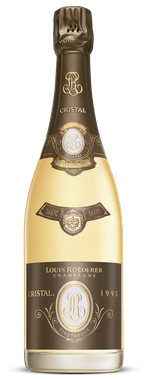
Three bottles each of the Cristal Vinoteque 1995 and Cristal Rose Vinoteque 1995 have just arrived in South Africa. Both are significantly different from the original releases, having spent ten years on the lees and now more than ten years on the cork. In that time they have acquired great richness and intensity, while still managing the celebrated tightrope between fruit, freshness, and maturity which can only be wrought upon the very best champagnes by the power of time.
Of the former it has been said that “Cristal Vinothèque 1995 displays the extraordinary ageing capacity of Cristal which, after 20 years, shows balance, complexity and a unique harmony, while retaining all of its purity and freshness.” Of the latter “Cristal Rosé Vinothèque 1995 has a succulent, juicy character, yet is amazingly fresh and lingers long on the palate. It embodies the grace and refinement inherent in a fine champagne.”
A Perfect Score
If you care enough about great wine to indulge yourself in one of the undisputed benchmarks at the peak of perfection, now is the time to consider acquiring a bottle or two of these extraordinary examples. Jancis Robinson has just scored the Cristal Rose 1995 Vinoteque bottling 20 out of 20 and James Suckling has given it the perfect 100 score.