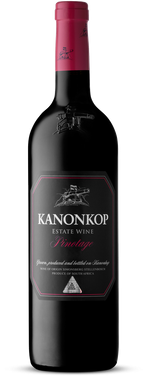
This year’s release is set to create unrivalled demand for the icon Pinotage as it follows a few weeks after Kanonkop became the first local winery to achieve a 100pt rating from international wine critic Tim Atkin.
Atkin’s perfect score for the Kanonkop Paul Sauer 2015 led to a demand which was unrivalled in the history of the Stellenbosch estate, with the wine sold-out within days. The new release of Kanonkop’s rare Black Label Pinotage, this from the 2017 harvest, is set to parallel the demand for the 100pt Paul Sauer as this special Pinotage has been particularly sought-after since its maiden release from the 2006 vintage and is produced in limited volumes.
“The 100pt rating was most certainly a terrific boost for the brand,” says Johann Krige, co-proprietor of Kanonkop. “We have never experienced such a demand for the Paul Sauer and it looks as though the interest is spilling over into our next release, namely the Black Label Pinotage 2017 of which only 6 900 bottles are available – far less than the Paul Sauer 2015.”
Added to this scarcity factor is the fact that there will be no Black Label 2018 vintage released next year, the wine from this vintage only hitting market end of 2020 after an extra year in the bottle, with follow up releases annually thereafter.
Black Label is made from one of the oldest Pinotage vineyards in South Africa, one planted in 1953 on a site that has over the years proved to produce fruit of specific excellence and deemed special enough to be bottled under an own label.
According to Kanonkop cellarmaster Abrie Beeslaar, the 2017 vintage was truly excellent for the Black Label. “It did not initially look as if this was going to be the case, as 2017 was the third very dry year in a row on the farm,” he says. “We only had 500mm of rain, 250mm less than the long-term average.”
As the summer kicked in and harvest was about to commence, however, the temperatures became mild and temperate. “The cool nights were a real blessing as this makes for even ripening and fruit-freshness,” says Beeslaar. “And then, lo and behold, we had some rain on the 23rd and 27th of January allowing the Black Label block to ripen without too much stress. Bunches were smaller and the harvest lighter due to the dry growing conditions, but the larger skin-to-flesh ratio in the berries resulted in magnificent, expressive flavours.”
Describing the bottled wine, Beeslaar says the emphasis is on elegance. “The nose is complex, packed with red berries, rose petals and perfume, with the structure being formidable and full while being extremely elegant. When that old vineyard hits the right notes, everything is seamless and balanced, and the 2017 is one of those vintages.”
Krige says that demand for the wine since the first release has outstripped all expectation.
“Year-by-year the response to the Black Label release grows,” he says. “I think this is not only due to the image of Kanonkop and its Black Label, but also as a result of the astounding critical reception the wine has received. When you have a sought-after product which is also garnering great scores from wine critics such as Tim Atkin (97/100) and Steven Tanzer (94/100) it truly begins to look like a match made in heaven.”
Each year’s Kanonkop Black Label is made to a tried-and-tested method based on simplicity and minimum intervention, says Beeslaar. “The fermenting juice was removed from the skins after four days, with malolactic fermentation commencing in stainless steel tanks before being completed in new French oak barrels. Maturation in new wood was done over 18 months to sculpt tannins and give the inherent fruit flavours structure and palate-weight.”
Beeslaar says that while being elegantly drinkable in its youth, it will develop magnificently over the next 20 years.
Each wine is individually numbered and labelled with a hologram to ensure authenticity.