While Champagne houses now release new cuvées with much the same enthusiasm and regularity as fashion houses launch the new season’s fashions, this was not always the case. Until the 1970s, most were happy to offer the house blend (a non-vintage cuvée whose purpose was to represent the house style), a vintage wine in good years, and perhaps a small volume of rosé and demi-sec. A few of the better-established brands also produced a prestige cuvée, though until 50 years ago there were fewer than a dozen of these from the entire region.
Things are not quite the same anymore: the demands of different markets – as well as the burgeoning size of the marketing departments, have imposed ever greater demands on the wine-making team. Still, the one certainty, the seemingly unchanging and unchangeable face of Champagne, has been the presence of the Brut Non-Vintage blend, which gives consumers the certainty of a house style.
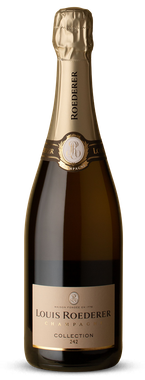
Now, this has changed – at least at Champagne Louis Roederer. The launch of Champagne Louis Roederer Collection 242 represents what is probably the most significant transformation in the past fifty years and one of the most important innovations since the House began making champagne in 1776.
Collection 242 will replace Brut Premier as the cellar's non-vintage blend, though the change is much less one of name and much more one of an approach to producing champagne. To have arrived at the concept of the Collection, the Rouzaud Family and Roederer’s Chef de Cave Jean-Baptiste Lécaillon have been working for over two decades transforming the viticulture and tweaking the style of Champagne.
To understand how this came about it is important to be aware of some of the key elements in the equation
- Champagne Louis Roederer owns or controls over 80% of the vineyards which supply its fruit. This is a unique situation amongst the Grandes Marques Champagne houses.
- For almost twenty years, it has been converting its vineyards to organic – and more recently bio-dynamic – viticulture.
- The result of this effort is the fruit of great purity and luminosity.
With access to grapes from the region's best vineyards now all farmed in a way that best expresses the variety and the site, it became essential to change the way the wine was produced.
Whereas in the Champagne region, traditionally grape quality and vintage difference were subsumed under production method and “house style”, it now became essential to re-engineer what is meant by “house style” by making fruit purity and the vinification method the defining features.
Every year will see the release of a new collection, a single assemblage comprising wine from a Perpetual Reserve (which is now already ten years old), together with a portion of the wine aged in oak, and the remainder of the harvest from a single vintage. The reserve wines are intended to provide stylistic consistency, the vintage portion will give individuality to each of the collections.
Our first Champagne Louis Roederer Collection shipment has arrived in South Africa. It is the Collection 242, so named because it is the 242nd blend since the foundation of the House in the 18th century. It comprises 34% Perpetual Reserve, 10% oak-aged reserve, and 56% wine from the 2017 vintage.
By its very nature it can never be reproduced and nor, according to Lecaillon, should that ever be attempted. Each collection will have its own personality, partly driven by the vintage which dominates the cuvée, partly by the ever-evolving Perpetual Reserve.
By its very nature it is finite, and in that sense rare, one-of-a-kind. It will be replaced by the next collection - Collection 243 – which will be released later this year. Though it will share the DNA, it can never be a twin, but rather a member of the same family recognisably connected, but an individual in its own right.